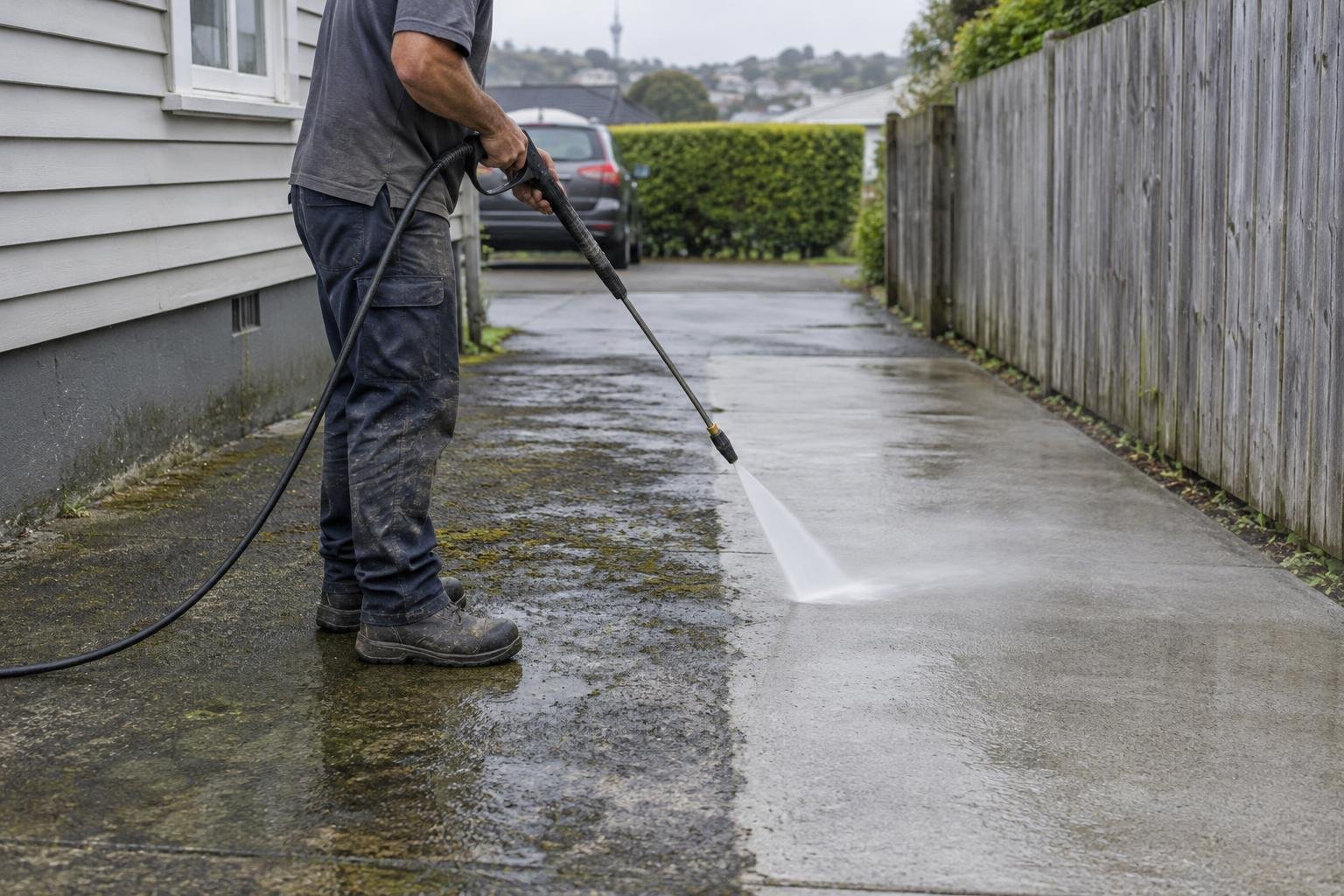
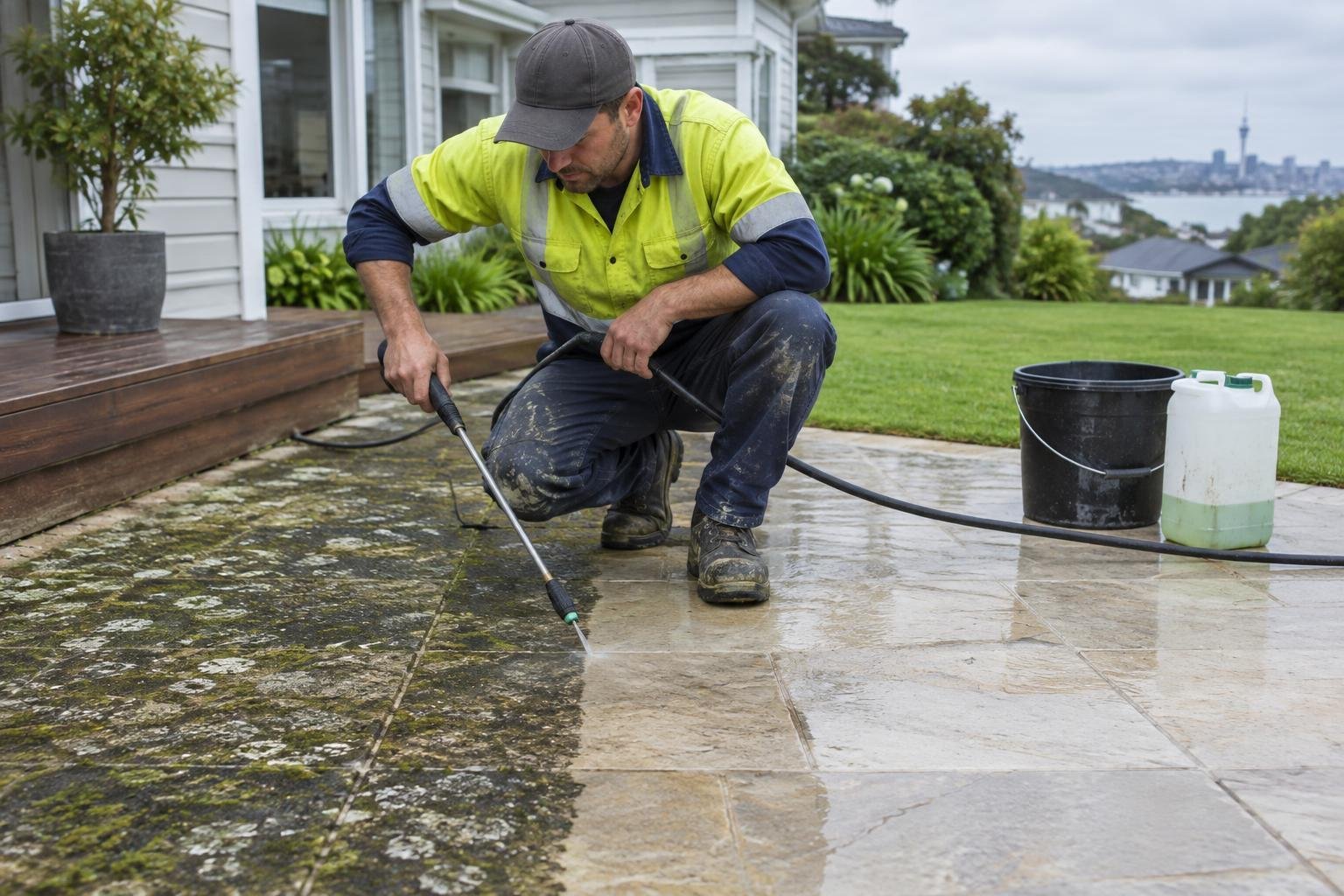
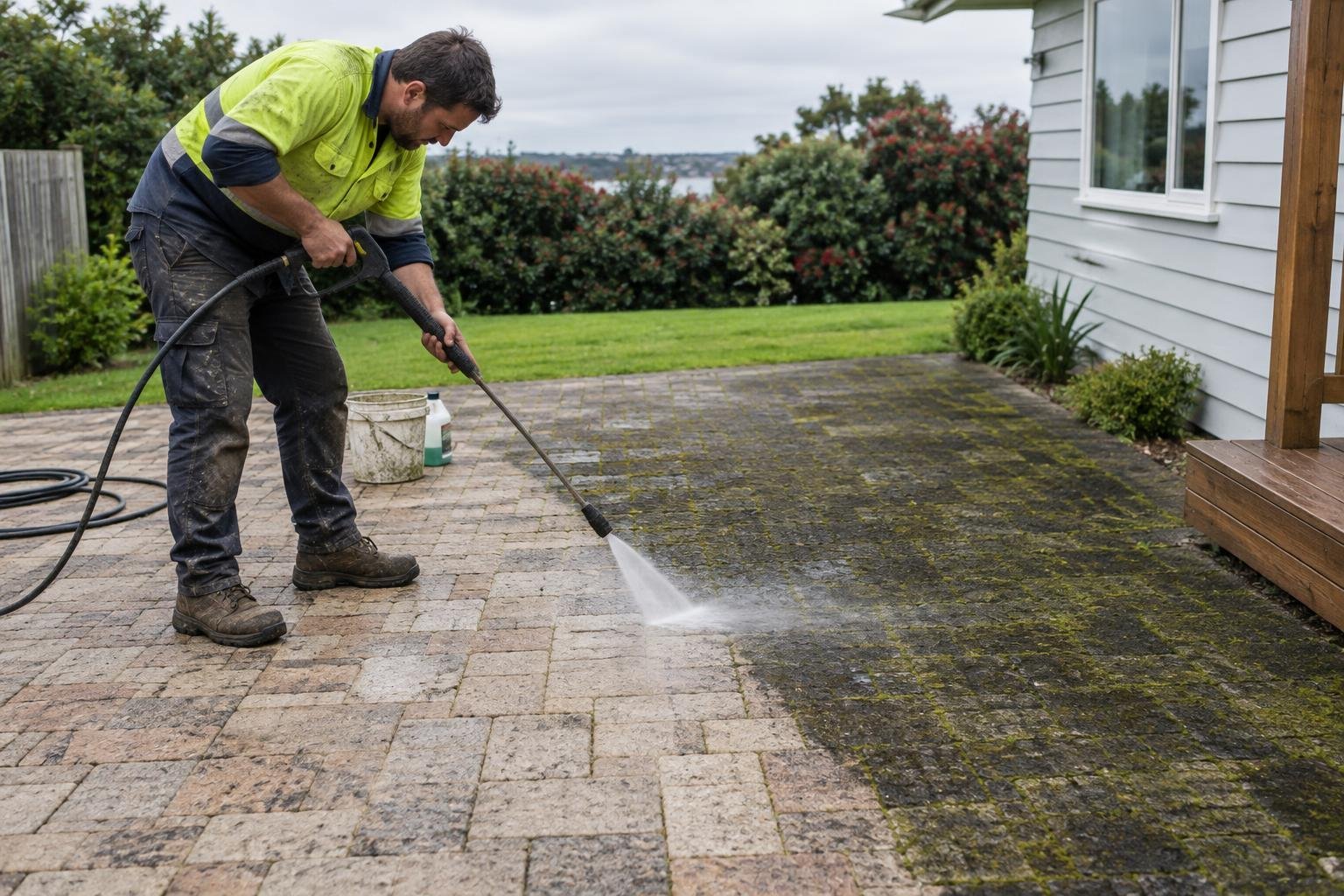
Your brick and limestone pavers are turning black and green far faster than you’d expect, and standard pressure washing is making it worse. Unlike solid concrete driveways, paved surfaces demand specialised techniques—too much pressure washes out the stabilising sand between joints, compromising structural integrity and aesthetic appeal. Auckland’s humid climate accelerates moss and algae growth on porous paver materials, yet many property owners don’t realise that professional paved surface cleaning Auckland requires entirely different methods.
The good news? Professional paver cleaning doesn’t just remove discolouration—it restores your outdoor living area to like-new condition whilst preserving joint sand and surface integrity. With the right pressure settings, tailored cleaning solutions, and expert technique, brick, limestone, and composite pavers transform dramatically, revealing colours buried beneath years of biofilm growth.
This guide reveals exactly how professional paver cleaning works, why it differs from concrete cleaning, and how resealing after washing protects your investment long-term. Discover the techniques that deliver stunning visual transformation without damage.
- Paved surfaces demand specialised pressure settings to preserve joint sand: Unlike solid concrete, pavers require low-pressure washing techniques (1500–2000 PSI) to remove moss, algae and lichen without displacing the stabilising sand between joints.
- Auckland’s humid climate accelerates moss and algae growth on pavers: Brick, limestone and composite pavers discolour faster than concrete driveways due to surface porosity, requiring tailored cleaning schedules and preventative sealing to maintain colour restoration.
- Professional colour restoration transforms faded pavers dramatically: Specialised cleaning solutions and techniques safely rejuvenate brick, limestone and composite surfaces while maintaining structural integrity and aesthetic appeal.
- Resealing after pressure washing protects long-term surface durability: Professional paver cleaning followed by re-sanding and sealing prevents regrowth of moss and algae whilst extending the lifespan of your outdoor living area.
Why Paved Surfaces Demand Specialist Cleaning Techniques
Auckland property owners often assume that paved patios, pathways, and outdoor living areas can be cleaned using the same high-pressure techniques applied to solid concrete driveways. This assumption creates a costly mistake. Paved surfaces—whether brick, limestone, or composite pavers—require fundamentally different cleaning approaches than monolithic concrete, and the distinction centres on a single critical element: joint sand.
Unlike solid concrete, paved surfaces consist of individual units separated by joints filled with sand or polymeric compounds. These joints serve as the structural foundation that allows for subtle movement, thermal expansion, and drainage. When standard pressure washing services blast paved surfaces with 3000+ PSI (the typical setting for concrete driveways), the concentrated pressure doesn’t just remove dirt—it excavates joint sand, destabilises the paver base, and creates conditions for subsidence, water pooling, and accelerated deterioration.
Paved surface cleaning Auckland specialists operate at dramatically lower pressures, typically 1500–2000 PSI depending on material type, combined with rotary nozzles and fan-spray patterns that distribute force evenly rather than concentrating it into destructive points. This technique distinction is not merely technical preference—it is the foundational difference between colour restoration and structural preservation versus short-term cleanliness followed by accelerated damage.
Auckland’s Humidity: Why Pavers Discolour Faster Than Concrete
Auckland’s humid subtropical climate creates a perfect environment for biofilm, algae, and moss proliferation on porous paver surfaces. Temperatures averaging 15°C in winter and 24°C in summer, combined with humidity levels that frequently exceed 70% and frequent rainfall, establish conditions where moisture penetrates paver surfaces and remains trapped within pores—creating ideal breeding grounds for biological growth far more aggressive than on sealed concrete.
Brick and limestone pavers, inherently porous materials, absorb moisture and develop black, green, or brown staining far more rapidly than solid concrete in Auckland’s conditions. Property owners frequently describe their paved patios turning “black almost overnight” during autumn and winter months when humidity peaks and thermal cycling accelerates moisture retention. This discolouration is not surface dirt—it is established biofilm communities embedded within the paver matrix, requiring specialist chemistry and pressure control to remove without damaging the underlying material or joint integrity.
Composite pavers, though less porous than natural stone, still develop algae and moss growth in shaded or high-moisture areas of Auckland properties, particularly where afternoon shade combines with proximity to garden beds or water runoff. Standard pressure-washing approaches fail on these surfaces because they attempt to blast biofilm away rather than chemically break it down, resulting in either incomplete removal or joint sand loss.
Material-Specific Cleaning: Brick, Limestone, and Composite Pavers
Each paver material demands distinct pressure settings and chemical treatments. Brick pavers tolerate slightly higher pressures (1800–2000 PSI) but require alkaline-based cleaners that break down organic staining without compromising mortar integrity. The challenge with brick lies in uneven colour variation across surfaces—improper technique can create patchy appearance where cleaned areas appear noticeably brighter than protected zones.
Limestone pavers demand the most delicate approach (1500–1700 PSI) because limestone is a calcium carbonate base susceptible to acid damage. Many standard commercial cleaners are too acidic and can etch limestone surfaces, creating dull, mottled finishes. Block paving cleaning Auckland specialists use pH-neutral or slightly alkaline solutions that dissolve biofilm without chemical attack on the stone itself.
Composite pavers require the most restraint—typically 1600–1900 PSI—because excessive pressure can chip or degrade the engineered surface. Biodegradable surfactants combined with lower pressures effectively remove algae and moss whilst preserving the original finish. Nozzle angle and dwell time (contact duration) become critical variables for composite surfaces, as rotating patterns prevent concentrated heat and pressure accumulation.
Preserving Joint Sand: The Critical Differentiator
Joint sand is not merely cosmetic filler—it is a structural system that permits controlled drainage, accommodates paver movement, and prevents subsurface erosion. When pressure washing excavates joint sand, it creates voids beneath pavers where water accumulates, accelerating deterioration and creating conditions for uneven settling or “lippage” (height variation between adjacent pavers).
Specialist paver cleaning services employ multi-step joint protection protocols: pre-treatment assessment identifies existing sand condition, low-pressure washing with fan nozzles (never zero-degree jet streams) removes biofilm without excavation, and post-cleaning stabilisation applies polymeric sand stabilisers or re-sanding where necessary. This approach is labour-intensive and requires trained technicians—which explains why generic pressure washing remains common despite inferior outcomes.
Colour Restoration and Long-Term Maintenance in Auckland’s Climate
When biofilm is removed correctly using specialist techniques, the visual transformation is dramatic. Brick pavers reveal rich, warm reds beneath years of black algae. Limestone surfaces regain their natural cream and gold tones. Composite finishes return to their original texture and colour definition. This restoration isn’t cosmetic alone—it reflects structural stability and proper maintenance investment.
For Auckland properties, annual cleaning of high-traffic paved areas combined with biennial cleaning of less-exposed surfaces prevents biofilm establishment and maintains both aesthetic and structural integrity. Paver cleaning Auckland services should include resealing recommendations every 2–3 years—critical in Auckland’s humid environment where moisture penetration accelerates deterioration. Property owners who invest in specialist maintenance avoid the false economy of DIY pressure washing, which often requires aggressive repeat treatments that compound structural damage over time.
Specialist Paver Cleaning: A Structural Investment, Not a Shortcut
Paved surfaces in Auckland demand fundamentally different cleaning approaches than solid concrete—pressure, chemistry, and technique must align with material type and local climate conditions. The difference between specialist paved surface cleaning and standard pressure washing is the difference between structural preservation and accelerated deterioration. Protecting joint integrity whilst removing biofilm requires trained technicians, material-specific protocols, and long-term maintenance planning.
Auckland’s humid subtropical conditions make professional care non-negotiable for brick, limestone, and composite pavers. Rather than risking joint sand excavation and subsurface damage with DIY approaches, invest in specialist paver cleaning services that deliver both aesthetic restoration and structural longevity. Your patio’s durability depends on this choice.